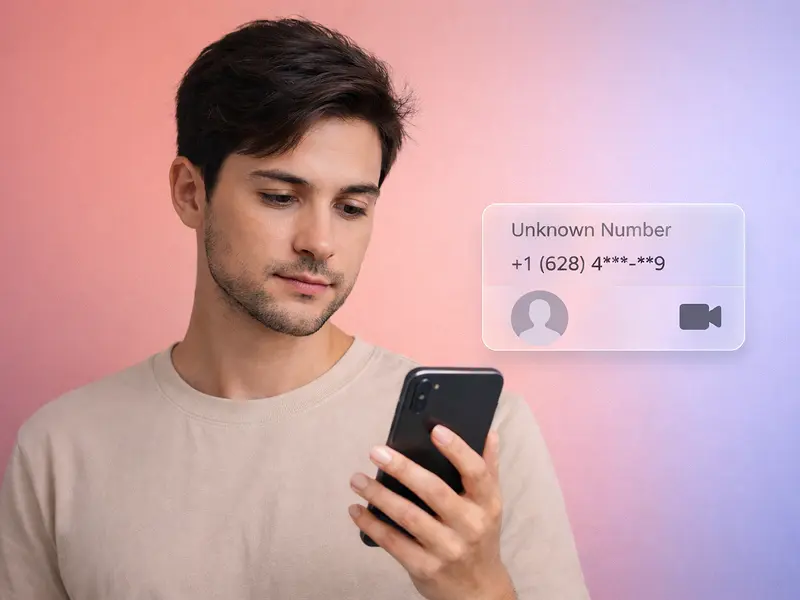
The telecommunications industry is now shifting away from “blocking bad actors” — a reactive approach that has proven ineffective — toward “verifying good actors.”
Predicting spam will always be an imperfect game. Proving identity and intent before a conversation begins is a more durable solution.
This is where video verification enters the equation.
It represents a transition away from data-based verification, which can be fabricated, toward visual verification, which provides immediate human context.
Understanding how to verify callers with video requires looking beyond traditional video calls. This is not about replacing phone calls with Zoom meetings. It is about restoring the digital handshake – knowing who is calling before deciding to answer.
Why traditional caller verification no longer works?
To understand why video is the necessary next step, it helps to examine where current verification methods fail.
Caller ID itself is the most obvious example. Built in an era when telephone operators were trusted monopolies, the SS7 signaling protocols that underpin global telecom networks were designed for connectivity, not security. As a result, spoofing a phone number is trivial. Bad actors can manipulate signaling data to impersonate banks, hospitals, government agencies, or even local contacts.
The digits displayed on a phone screen no longer represent proof of origin.
Attempts to patch this system have helped, but they have not solved the core problem. Protocols like STIR/SHAKEN digitally sign calls to verify that a caller is authorized to use a particular number. This reduces certain types of spoofing, but it still lacks context. A verified number confirms a device – not the person using it, and not their intent.
At the same time, aggressive call spam filtering has introduced a new problem: false positives. Legitimate businesses are frequently flagged as “Spam Likely” simply because they make a high volume of calls.
Delivery drivers, healthcare providers, and service technicians often find their calls ignored or blocked entirely, even when the call is legitimate and time-sensitive.
Other verification methods have proven equally fragile. One-time passwords and security questions verify possession of data or devices, not identity. These systems are vulnerable to SIM swapping, social engineering, and leaked personal data. In an audio-only environment, trust relies entirely on voice — a growing liability in an era of AI-generated speech and deepfake impersonation.
Without visual confirmation, authority can be convincingly faked.
What video-based caller verification actually is?
Video-based caller verification is not a single feature. It is a shift in how calls are authenticated.
Instead of receiving a call accompanied only by a name and number, the recipient sees a live or pre-recorded video preview of the caller before answering. This functions as a visual knock.
People already use this model elsewhere:
- video doorbells
- peepholes
- security camera previews
The same instinct applies to calls. Visual information carries more density than metadata. Facial cues, environment, and context are assessed almost instantly.
A text label claiming “Service Technician” can be spoofed. A live video showing a technician:
- in uniform
- near a branded vehicle
- speaking naturally in real time
…is far harder to fake convincingly.
Critically, video verification operates as a preview layer.
The caller provides visual proof; the recipient remains off-camera. This asymmetry matters. The recipient gains clarity without exposure. The burden of legitimacy rests with the caller.
How verifying callers with video works in real life?
The impact of video verification becomes most apparent in everyday scenarios where ambiguity currently causes friction.
In financial services, customers receiving fraud alerts are immediately defensive. With video verification, legitimacy is established before the call begins. The recipient sees a real agent in a professional environment, often with clear branding. The conversation starts from trust rather than skepticism.
In the service and gig economy, video previews solve the “unknown number” problem. A driver or technician can show:
- the delivery order
- the building entrance
- their uniform or ID
Context is understood instantly.
Personal communication benefits as well. Calls from borrowed or temporary numbers are no longer ignored when identity can be confirmed visually.
The human face replaces anonymous digits, restoring the phone network’s ability to support urgent or unexpected communication.
Trust, privacy, and consent in video verification
Privacy concerns around video are valid, but video verification is often more privacy-preserving than existing methods.
Traditional verification flows frequently require:
- reading sensitive information aloud
- receiving codes on the same device
- granting screen access to support agents
Video verification avoids this by proving identity visually. The caller opts in to transmit video. The recipient is never required to activate their camera.
Well-designed systems emphasize:
- explicit consent
- end-to-end encryption
- minimal data retention
Video functions as a credential, not surveillance.
It is a momentary act of identification — not continuous monitoring. By placing the verification burden on the caller, these systems protect recipients while filtering out actors who rely on anonymity.
Why video will become the default verification layer?
The broader trajectory of technology makes this shift inevitable.
We already rely on visual identity for:
- unlocking devices
- approving payments
- social communication
Voice-only calling is one of the last channels without built-in visual trust.
Network speeds, device capabilities, and user expectations have converged. Users want transparency. Blind trust is no longer acceptable.
Just as Caller ID replaced the anonymity of early phone systems, Video Caller ID will replace the ambiguity of the smartphone era. Platforms like FaceCall are early signals of this shift, building identity-first calling systems where visual verification happens before engagement – becoming a strong layer of call screening.
Soon, answering a call without seeing the caller will feel outdated. Trust will be established before the first word is spoken.
Verifying callers with video is not merely a security feature. It is a human-centered evolution of communication — aligning technology with how people naturally decide who to trust.
What successful video verification systems get right?
Not all implementations of video verification will succeed. The effectiveness of this model depends heavily on execution. Systems that work share a few common characteristics.
- They are fast. Verification must happen within seconds, not as a delayed preview that interrupts flow.
- They are optional. Both caller and recipient retain control.
- They are contextual. The video explains why the call is happening, not just who is calling.
- They are respectful. No forced exposure, no persistent recording, no hidden data capture.
When these principles are ignored, video becomes intrusive. When they are respected, video becomes invisible—simply another layer of clarity that users quickly take for granted.
This is why early platforms in this space, including FaceCall, are focused less on “video calling” and more on identity signaling. The value lies not in the novelty of video, but in the confidence it restores.
Conclusion
Voice-only calling no longer provides the trust modern communication demands. As spoofing and impersonation grow, visual context becomes the most reliable way to verify identity before engaging.
Video-based caller verification restores confidence by letting people see who is calling and why, before answering.
Video caller ID frameworks like FaceCall are built around this principle, using Video Caller ID as a verification layer rather than a conversation requirement. In the future, trust won’t be assumed. It will be visible.